

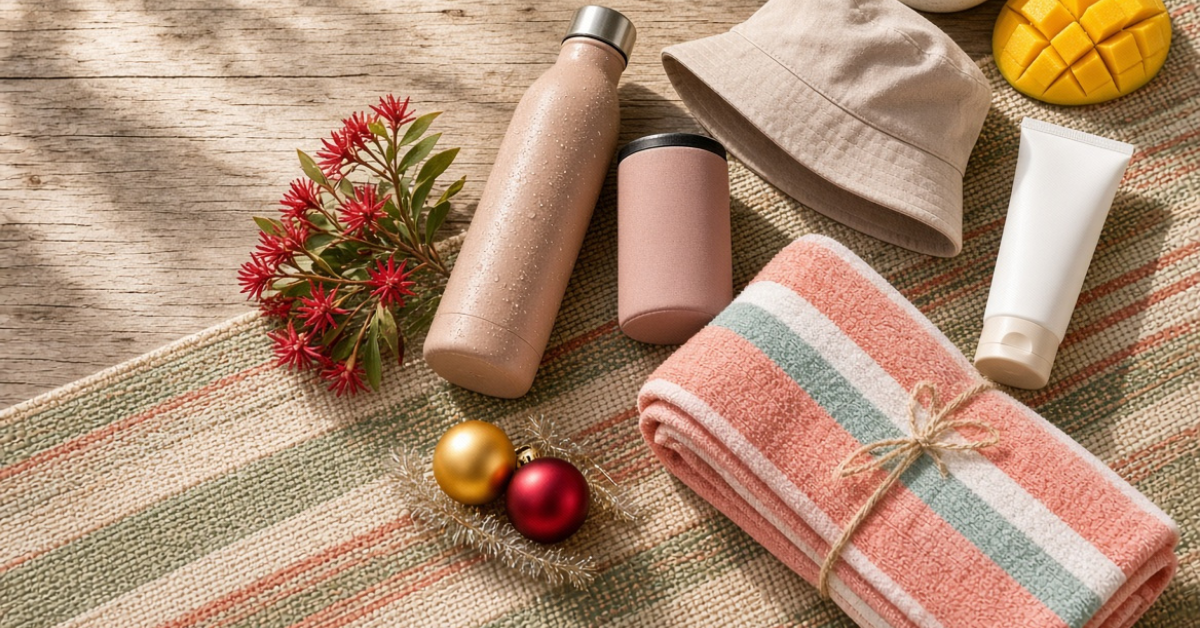
Every year, we watch the same thing happen. Marketing teams leave their Christmas merchandise until mid-November, then scramble for whatever stock suppliers have left. They pay rush fees, settle for second-choice products and launch late.
The brands, who know when to order Christmas gifts on time, get the most out of the happiest season while everyone else is still watching the footy finals.
This guide shows you how to plan a Christmas promotional campaign with branded merchandise, step by step. It covers giveaways, gift-with-purchase offers, event merchandise and, most importantly, how to measure what worked.
Key Takeaways
- Christmas promotional products are branded items that businesses give to customers during the festive season to drive sales, foot traffic or brand awareness.
- Set one clear goal first. Your goal decides your product, your campaign format and how you measure success.
- Start planning in August or early September. Custom orders need time for samples, artwork approval, production and delivery. We recommend allowing at least eight weeks.
- Remember it's summer. Australians celebrate Christmas in the heat, so products like drink bottles, cooling towels and beach gear get far more use than beanies and scarves.
- Choose the right format. Giveaways build awareness, gift-with-purchase offers lift sales, and event merchandise draws crowds.
- Track results with simple tools such as unique discount codes, QR codes and redemption counts.
What is a Christmas Promotional Campaign?
A Christmas promotional campaign is a planned marketing push that runs during the festive season and uses branded merchandise to reach a specific business goal.
Here's how it works. You choose a useful product, add your logo, and give it to customers in a way that encourages them to act. That might mean buying something, visiting your store, signing up to your email list or stopping at your stall.
It matters because Christmas is the busiest shopping period of the year. Customers already expect offers and gifts, so a well-chosen product gives them a real reason to pick your brand over the one next door.
This approach suits retailers, hospitality venues, event organisers, shopping centres, service businesses and any brand that wants to stand out during the December rush.
Why Christmas Promotional Products Work for Marketers
Christmas promotional products work because they give customers something useful that stays with them long after the season ends.
- Feature: A physical, branded item that people use.
- How it works: The customer takes the item home and uses it again and again. Your logo appears every time they reach for it.
- Outcome: Your brand stays in view for months, not just for the length of an ad.
Digital ads disappear the moment someone scrolls past. A good drink bottle sits on a desk, rides in the car and heads to the beach all summer. In our experience, the products that deliver the best value are the ones people use without a second glance at the logo.
Christmas also puts people in a generous, gift-giving mood. A free item at this time of year feels like a small present rather than a marketing tactic, and that goodwill rubs off on your brand.
Step 1: Set One Clear Goal
Your campaign needs one main goal. When you try to do everything at once, you end up measuring nothing.
Pick the goal that matters most to your business this December, then let it guide every other decision.
| Your goal | Best campaign format | What to track |
|---|---|---|
| More sales | Gift with purchase | Number of sales over the spend threshold |
| Higher spend per customer | Gift with purchase with a set minimum spend | Average sale value compared with last year |
| More store visits | In-store giveaway or collect-in-store offer | Redemptions and visitor numbers |
| New email subscribers | Giveaway in exchange for sign-up | New sign-ups during the campaign |
| Brand awareness at events | Event merchandise | Items handed out and follow-up visits or scans |
Our tip: Write your goal as a single sentence with a number in it. For example, "Get 500 new email subscribers by 20 December." A specific target makes it far easier to judge success later.
Step 2: Build Your Christmas Campaign Timeline
The best time to start planning a Christmas promotional campaign in Australia is late August or early September.
Custom merchandise takes longer than most people expect. You need time to choose products, check samples, approve artwork, produce the order and get it delivered. Freight also slows down in the weeks before Christmas, and many suppliers close over the holiday break.
Here's the timeline we recommend:
| When | What to do |
|---|---|
| August | Set your goal, budget and campaign format |
| Early September | Shortlist products and request samples |
| Late September to early October | Approve artwork and place your order |
| Late October to mid-November | Receive stock, brief your team and set up tracking |
| Late November to December | Launch and run the campaign |
| January | Review results and note lessons for next year |
If you've missed these dates, don't panic. Choose products your supplier keeps in stock, keep your branding to one colour and ask about realistic delivery dates before you commit.
Step 3: Choose Products That Suit an Aussie Summer Christmas
The best Christmas promotional products for Australian customers are items people will use during the hot summer months.
Many Christmas marketing ideas come with a Northern Hemisphere feel. Snowflakes, knitted beanies and mugs for hot chocolate look festive, but they don't match what Australians do in December. We head to the beach, fire up the barbecue, go camping and gather outdoors.
Choose summer promotional products that fit those plans:
- Insulated drink bottles: Keep drinks cold on hot days and get used all year round.
- Stubby holders: A classic Aussie item that suits barbecues and backyard gatherings.
- Cooling towels: A practical gift for outdoor events and summer sport.
- Beach towels: A large branding space that people bring out every weekend.
- Branded sunscreen: Useful, affordable and perfect for Christmas markets and outdoor events.
- Bucket hats and caps: Popular with families and great for summer festivals.
- Picnic rugs and cooler bags: A higher-value option for premium gift-with-purchase offers.
- Handheld fans: Low cost and ideal for crowded events.
A few expert tips:
- Skip the year on the design. Printing "Christmas 2026" on a product gives it an expiry date. A subtle festive touch, or no festive touch at all, keeps it useful well into the new year.
- Keep your logo tasteful. People keep and use products that look good. A huge logo often sends an item straight to the back of the cupboard.
- Match the product to your audience. A family-friendly retailer and a craft brewery need very different items.
- Look at sustainable options. More customers now prefer reusable and responsibly made items. Our range of eco-friendly promotional products makes a great starting point.


Step 4: Pick the Right Campaign Format
Most Christmas campaigns use one of three formats: giveaways, gift-with-purchase offers or event merchandise. Each one suits a different goal.
Christmas Giveaways
A Christmas giveaway hands branded products to customers for free, usually in return for a simple action.
That action might be signing up to your email list, visiting your store, following a simple entry process or attending a launch. Giveaways work best for building awareness and growing your customer list.
How to make a giveaway work:
- Ask for one simple action. The more steps you add, the fewer people take part.
- Choose a product people want. A cheap pen rarely convinces anyone to hand over their email address.
- Limit the quantity and tell people. "First 200 customers" creates a gentle sense of urgency.
- Follow up quickly. Send a welcome email or offer within a few days while your brand feels fresh.
Common mistake: Handing out items to anyone who walks past without collecting any details. You spread your logo around, but you have no way of reaching those people again or knowing if the giveaway worked.
If you run a competition where winners come down to chance, check the rules in your state or territory before you launch. Some places have specific requirements for these promotions.
Retail Gift-With-Purchase Offers
A gift-with-purchase offer gives customers a free branded product when they buy something or spend over a set amount.
This format directly lifts sales and can raise the amount each customer spends. It suits retailers, online stores, cafes and hospitality venues.
How to set up a strong gift-with-purchase offer:
- Set the right spend threshold. Pitch it a little above your usual average sale. If most customers spend $60, a threshold of $80 encourages them to add one more item.
- Choose a gift that feels worth it. The product should feel like a real bonus, not an afterthought.
- Make the offer easy to see. Display the gift at the counter, on shelves and on your website.
- Brief your staff. Your team should mention the offer at every sale. Many campaigns underperform simply because staff forget to tell customers.
- Add "while stocks last". This protects you if demand runs higher than expected.
Common mistake: Setting the threshold too high. If customers feel the spend target sits out of reach, they ignore the offer completely.
Event Merchandise for Markets and End-of-Year Events
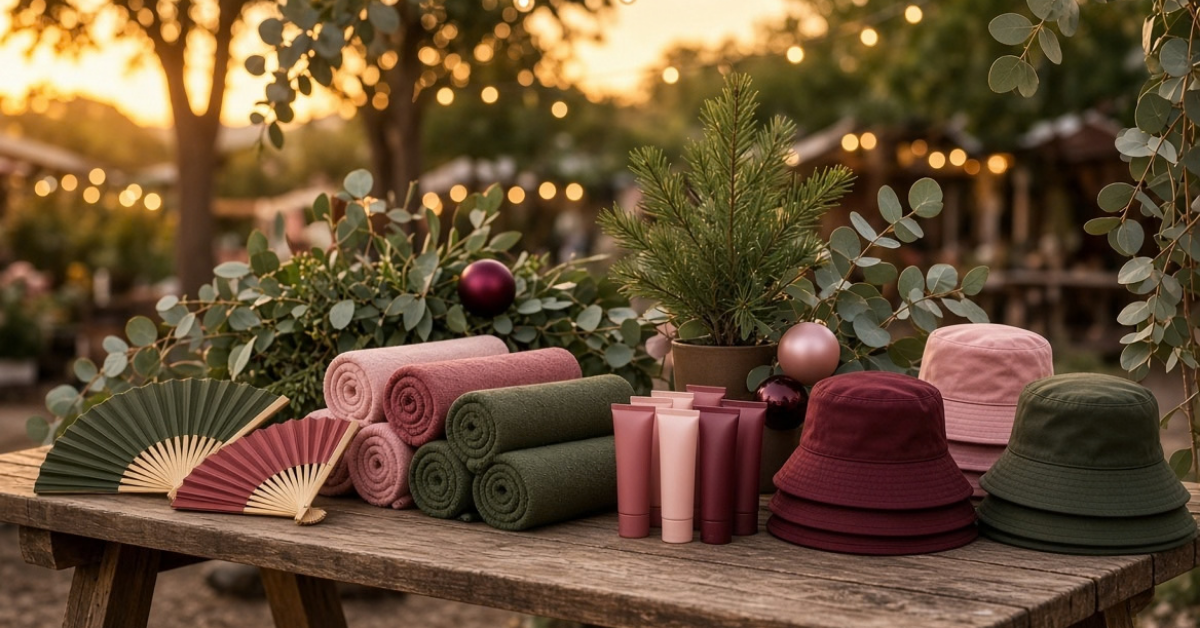
Event merchandise puts branded products into people's hands at Christmas markets, carols nights, community festivals, shopping centre activations and end-of-year functions.
These events attract big, cheerful crowds, which makes them ideal for brand awareness. The challenge lies in turning a quick stall visit into something more lasting.
How to get more out of event merchandise:
- Pick products that suit the setting. Handheld fans, sunscreen and cooling towels suit outdoor summer events perfectly.
- Add a reason to connect later. Attach a QR code that leads to an offer, a competition or a sign-up page.
- Tier your products. Offer a small item to everyone and save a higher-value product for people who sign up or buy.
- Plan your quantities by expected crowd size. Ask the organiser how many people attended last year.
Browse our promotional products for events for ideas that suit busy summer crowds.
Step 5: Work Out Your Budget and Quantities
Your Christmas merchandise budget should reflect what a new customer or sale is worth to your business.
Start with this simple question: how much can you spend to win one sale, one sign-up or one new customer? Then work backwards.
A simple way to estimate quantities:
- Estimate how many people your campaign will reach.
- Estimate how many of them will take up the offer.
- Add a buffer of around 10 to 15 per cent so you don't run out early.
Example: A gift shop expects around 3,000 customers over the three weeks before Christmas. The owner estimates one in five will spend over the threshold. That means around 600 gifts, plus a buffer, for an order of roughly 675 to 700 units.
These numbers act as an illustration only. Use your own sales history for a more accurate estimate. Last December's sales figures make the best starting point.
Our tip: Ordering a larger quantity usually lowers the price per item. If you plan to run a similar offer next year, and your design has no date on it, a bigger order can save you money.
Step 6: Plan How You'll Measure Results
You measure a Christmas promotional campaign by tracking the one goal you set in Step 1, using tools you set up before launch.
Too many marketers try to measure results after the campaign ends, when it's too late to collect useful information. Build tracking into the campaign from day one.
Simple ways to track results:
- Unique discount codes: Print a code on the product tag or insert card. Each time someone uses it, you know the merchandise did its job.
- QR codes: Link the QR code to a dedicated campaign page so you can count scans and sign-ups.
- Redemption counts: Keep a simple tally of how many gifts your team hands out each day.
- Sales comparisons: Compare sales and average spend with the same period last year.
- Email sign-ups: Count new subscribers during the campaign dates.
- Staff feedback: Ask your team what customers said about the offer and the product.
- Social posts: Watch for customers sharing photos of your product online.
Work out your cost per result. Divide your total campaign cost by the number of results. If you spent $3,000 and gained 400 new subscribers, each subscriber cost you $7.50. This figure helps you compare this campaign with your other marketing and plan next year's budget with confidence.
Once the campaign ends, write a short one-page summary. Note what worked, what didn't and what you'd change. Future you will thank you next August.
Common Mistakes to Avoid
We see the same problems pop up every Christmas. Avoid these and you'll already sit ahead of most of your competitors.
- Starting too late. Late orders limit your choices and often cost more.
- Choosing winter-themed products. They look great in a catalogue but rarely suit an Australian summer.
- Trying to hit too many goals. One clear goal beats five vague ones.
- Forgetting to track results. Without tracking, you can't prove the campaign worked or improve it next year.
- Picking the cheapest product. A product nobody wants wastes the whole budget, no matter how little it cost.
- Skipping the staff briefing. Your team drives the success of any in-store offer.
- Dating the design. A year on the product cuts its useful life short.
Your Christmas Campaign Checklist
Use this checklist to keep your campaign on track:
- ☐ Set one clear goal with a number attached
- ☐ Choose your campaign format
- ☐ Set your budget and estimate quantities
- ☐ Shortlist summer-friendly products
- ☐ Request samples and check the quality
- ☐ Approve artwork without a date on the design
- ☐ Place your order by early October
- ☐ Set up discount codes, QR codes or tracking sheets
- ☐ Brief your staff on the offer
- ☐ Launch in late November
- ☐ Track results daily or weekly
- ☐ Review the campaign in January
Start Early and Finish Strong
A successful Christmas campaign comes down to three things: a clear goal, a product people want to use, and a simple way to measure the results. Get those right, and your merchandise keeps working for your brand long after the tinsel comes down.
The earlier you start, the more choice you have and the less you'll pay.
Ready to start planning? Explore our range of Christmas promotional products or get in touch with our team. We'll help you find products that suit your goal, your audience and an Aussie summer Christmas.
FAQ Section
(Place this section before the conclusion when publishing.)
When should I order Christmas promotional products in Australia?
Order your Christmas promotional products by late September or early October. This gives you time for samples, artwork approval, production and delivery before the busy December period. Many suppliers also close over the holiday break, so late orders carry more risk.
What are the best Christmas promotional products for an Australian summer?
The best options suit hot weather and outdoor living. Insulated drink bottles, stubby holders, cooling towels, beach towels, sunscreen, bucket hats and cooler bags all work well because people use them throughout summer.
How does a gift-with-purchase offer work at Christmas?
A gift-with-purchase offer gives customers a free branded item when they spend over a set amount. Set the threshold slightly above your usual average sale to encourage customers to add one more item to their purchase.
How much should I spend on Christmas promotional merchandise?
Base your budget on what a new sale or customer is worth to your business. Estimate how many people will take up your offer, add a small buffer, then choose a product that fits the cost per result you can afford.
How do I measure the success of a Christmas promotional campaign?
Track the one goal you set before launch. Use unique discount codes, QR codes, redemption counts and sales comparisons with last year. Divide your total cost by the number of results to find your cost per result.
Can I use Christmas merchandise after the holiday season?
Yes, if you plan for it. Leave the year off the design and keep festive elements subtle. Useful summer products like drink bottles and beach towels keep promoting your brand well into the new year.
What makes a good Christmas giveaway item?
A good giveaway item feels useful, suits the season and matches your audience. People keep products they want to use, so choose quality over quantity and keep the branding tasteful.
How can I stand out with event merchandise at a crowded Christmas market?
Offer something that solves a problem on the day, such as a handheld fan or sunscreen on a hot evening. Pair it with a QR code that leads to an offer, so a quick visit turns into an ongoing connection.
Recent Posts
Comments