A new hire's first day says a lot about a company. If their welcome kit is a plastic-wrapped mug, a cheap lanyard, and a pen that stops working in a week, that's the message they receive before they've even opened their laptop. Sustainable employee onboarding gifts fix this problem. They give new starters something they'll actually use, while showing that your company thinks past the next quarter.
This guide breaks down what sustainable onboarding gifts are, why they matter, and how to choose them without getting lost in greenwashing.
Key Takeaways
- Sustainable employee onboarding gifts are welcome items made from responsibly sourced or recycled materials and produced under ethical labour practices.
- They work best when they combine three things: genuine usefulness, credible sustainability credentials, and a design that fits your workplace culture.
- The goal isn't to find the "greenest" possible item. It's to find gifts new hires will actually keep, use, and associate positively with your brand.
- Certifications like FSC, GOTS, Fair Trade, and OEKO-TEX are more reliable indicators of sustainability than marketing language alone.
- Fewer, better-quality items usually outperform large kits filled with low-value extras.
What Are Sustainable Employee Onboarding Gifts?
Sustainable employee onboarding gifts are welcome items given to new employees that are made using environmentally responsible materials and ethical manufacturing processes. This includes things like recycled aluminum drink bottles, organic cotton apparel, FSC-certified notebooks, and biodegradable packaging.
How it works: Instead of mass-produced, single-use promotional items, suppliers source materials with a lower environmental footprint, work with factories that meet fair labour standards, and design products meant to last.
Why it matters: New hires notice the difference between a gift that feels disposable and one that feels considered. A well-chosen sustainable kit signals that your company's values extend beyond a mission statement on the careers page.
Who it's relevant to: HR teams, people and culture leads, and employer branding managers responsible for the onboarding experience.
Why Do Sustainable Welcome Kits Matter for Australian Employers?
Sustainable welcome kits matter because they shape a new hire's first impression, reduce unnecessary waste, and demonstrate that a company's stated values are backed by action.
Do sustainable welcome kits improve retention and employer brand?
Yes. First impressions shape how long someone stays. A thoughtful, sustainable welcome kit is a small but visible way to show new employees the company follows through on its stated values, not just during recruitment marketing but from day one.
Do sustainable gifts actually reduce waste?
Yes, when chosen correctly. Traditional promotional merchandise has a well-known problem: much of it ends up in landfill within months. Choosing durable, reusable items (a good drink bottle, a quality notebook, apparel that gets worn) reduces the "junk drawer" effect that cheap branded merchandise usually creates.
Do employees actually care about sustainable onboarding gifts?
Increasingly, yes. Employees, particularly younger ones entering the workforce, expect employers to act on sustainability rather than just talk about it. Australian workplaces with formal ESG or corporate social responsibility commitments should treat onboarding gifts as part of that commitment, not separate from it.
Can a welcome kit support employer brand outside the workplace?
Yes. New hires often photograph or mention their welcome kit on social media or in conversations with peers. A sustainable, well-designed kit becomes informal employer brand marketing, at no extra cost.
What Makes a Corporate Gift Sustainable?
A corporate gift is genuinely sustainable when its materials, certifications, production process, and expected lifespan all reduce environmental impact, not just one of those factors in isolation.
What materials should sustainable gifts be made from?
Sustainable gifts use materials such as recycled plastic (rPET), organic or recycled cotton, bamboo, cork, or recycled aluminum and steel, instead of virgin plastic or unsustainably sourced timber.
What certifications should employers look for?
Credible sustainability claims are backed by recognised certifications, such as:
- FSC certification for paper and timber products, verifying responsible forestry (Forest Stewardship Council)
- GOTS certification for organic textiles
- Fair Trade certification for ethical labour practices
- OEKO-TEX certification confirming textiles are free from harmful substances
If a supplier can't point to a certification or clear sourcing information, treat sustainability claims with caution.
Does production and packaging affect sustainability?
Yes. Sustainable production reduces water use, energy consumption, and chemical waste. Packaging matters too: minimal, recyclable, or compostable packaging avoids undoing the benefit of a sustainable product.
Does the lifespan of a product matter as much as the material?
Yes, often more. The most sustainable item is one that gets used for years, not thrown out after one use. A durable stainless steel bottle beats a "biodegradable" item that breaks after a month.
What Should Go in a Sustainable New Hire Welcome Kit?
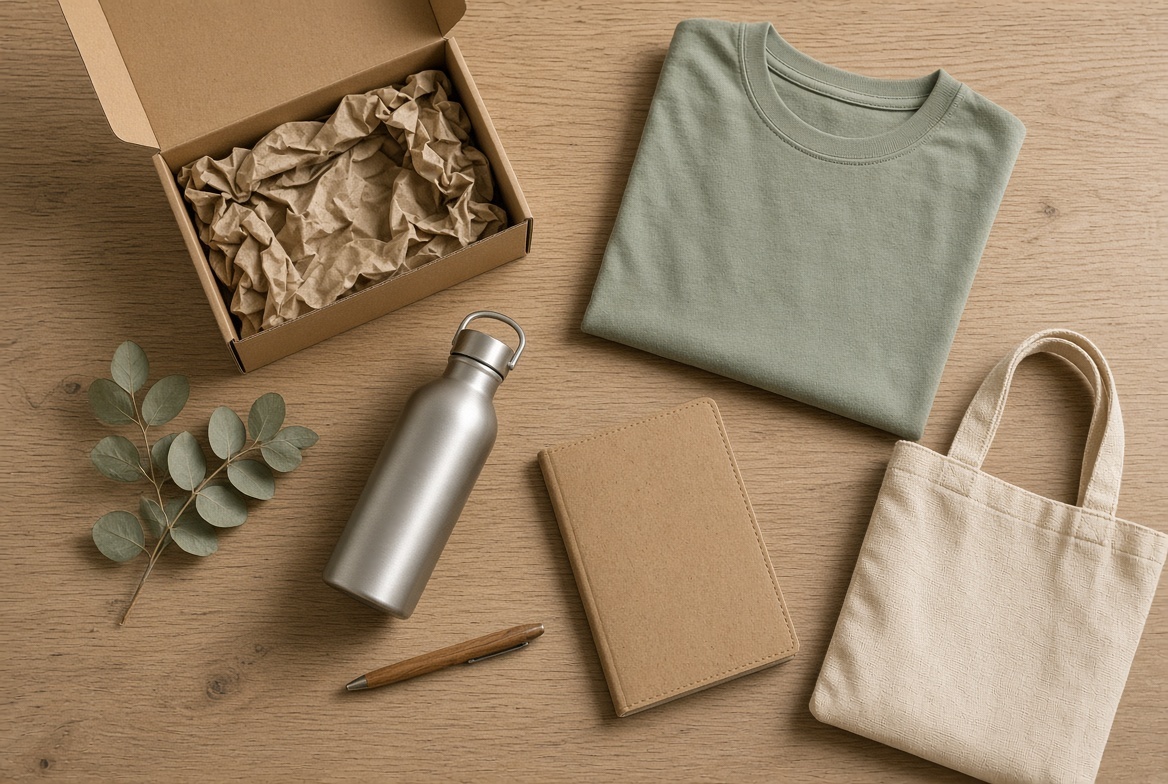
A good welcome kit doesn't need to be large. It needs to be useful. Here's a practical breakdown:
| Item |
Sustainable Option |
Why It Works |
| Drink bottle |
Recycled aluminum or stainless steel |
Replaces disposable bottles, gets daily use |
| Notebook |
FSC-certified recycled paper |
Practical for meetings and note-taking |
| Apparel (hoodie/tee) |
Organic or recycled cotton |
Wearable outside work, extends brand reach |
| Tote or backpack |
Recycled canvas or rPET fabric |
Useful for commuting, reduces plastic bag use |
| Pen |
Recycled plastic or bamboo |
Small item, but often the most-used |
| Welcome card/packaging |
Recycled or compostable materials |
Completes the sustainability story |
Keep the kit relevant to your workplace. A hybrid or remote team might value a good notebook and drink bottle over apparel, while a field-based team might prioritise durable, weather-appropriate items.
How Do You Choose Ethical Promotional Products?
You choose ethical promotional products by verifying certifications, checking manufacturing conditions, and prioritising items your team will genuinely use over items that simply look good in a photo.
Use this checklist when evaluating suppliers or products:
- Ask for certification documentation, not just marketing claims
- Check where the product is manufactured and under what labour conditions
- Confirm the material composition (recycled percentage, organic status)
- Assess packaging separately from the product itself
- Prioritise usefulness over novelty; ask "will a new hire actually use this in six months?"
- Request samples before committing to a bulk order
- Ask about minimum order quantities to avoid over-ordering and waste
- Consider local Australian suppliers to reduce shipping-related emissions
What Mistakes Do Employers Make With Sustainable Gifting?
The most common mistakes are buying on price alone, over-ordering "just in case," trusting vague green language, ignoring packaging, and treating sustainable gifting as a one-off gesture rather than an ongoing practice.
Buying based on price alone. The cheapest bulk order is often the least durable, which increases long-term waste rather than reducing it.
Over-ordering "just in case." Excess promotional stock frequently ends up unused and eventually discarded. Order based on realistic hiring forecasts.
Trusting vague green language. Terms like "eco-friendly" or "natural" aren't regulated. Certifications and material specifics matter far more than marketing copy.
Ignoring packaging. A recycled product wrapped in excess plastic packaging undermines the sustainability message.
Treating it as a one-off gesture. Sustainable onboarding gifts work best as part of a consistent employer brand approach, not an isolated initiative for one hiring round.
What Does This Look Like in Practice?
Consider a mid-sized professional services firm onboarding 15 new graduates each year. Instead of a generic branded show bag, the HR team switches to a smaller kit: a recycled aluminum drink bottle, an FSC-certified notebook, and a recycled cotton tote, packaged in a compostable box with a printed welcome note instead of plastic wrap.
The kit costs roughly the same per person as the previous show bag, but items are used daily rather than left in a drawer. New hires mention the kit in onboarding surveys as a positive first impression, and the firm can point to a concrete, values-aligned action rather than a general sustainability statement.
This kind of shift doesn't require a large budget increase. It requires choosing fewer, better items.
Sustainable employee onboarding gifts aren't about ticking a box or following a trend. They're a practical way to make a new hire's first day feel considered, while backing up your company's stated values with an action they can actually see and use. The employers who get this right focus on fewer, better items, verified sustainability credentials, and consistency across every hiring round.
If you're reviewing your onboarding kit for the year ahead, start with the checklist above and audit what you're currently sending new hires. It's often the simplest place to make an immediate, visible improvement.
FAQ
What are the best sustainable gifts for new employees?
Reusable drink bottles, FSC-certified notebooks, and organic or recycled cotton apparel are consistently the most-used items in employee welcome kits, because they fit into daily routines rather than sitting unused.
Are sustainable corporate gifts more expensive than standard promotional products?
Not necessarily. While some sustainable materials carry a premium, choosing fewer, higher-quality items instead of a large volume of cheap merchandise often balances out the cost, while improving usage rates.
How do I know if a promotional product is genuinely sustainable?
Look for recognised certifications such as FSC, GOTS, Fair Trade, or OEKO-TEX, and ask suppliers directly about material sourcing and manufacturing conditions. Marketing terms like "eco-friendly" without supporting evidence aren't reliable indicators.
Should sustainable onboarding gifts be branded with our logo?
Yes, in most cases. Subtle branding keeps the item useful and wearable rather than overtly promotional, which increases the likelihood a new hire will use it long-term.
How many items should a new hire welcome kit include?
There's no fixed number, but three to five well-chosen, high-use items typically work better than a larger kit filled with low-value extras.







Comments